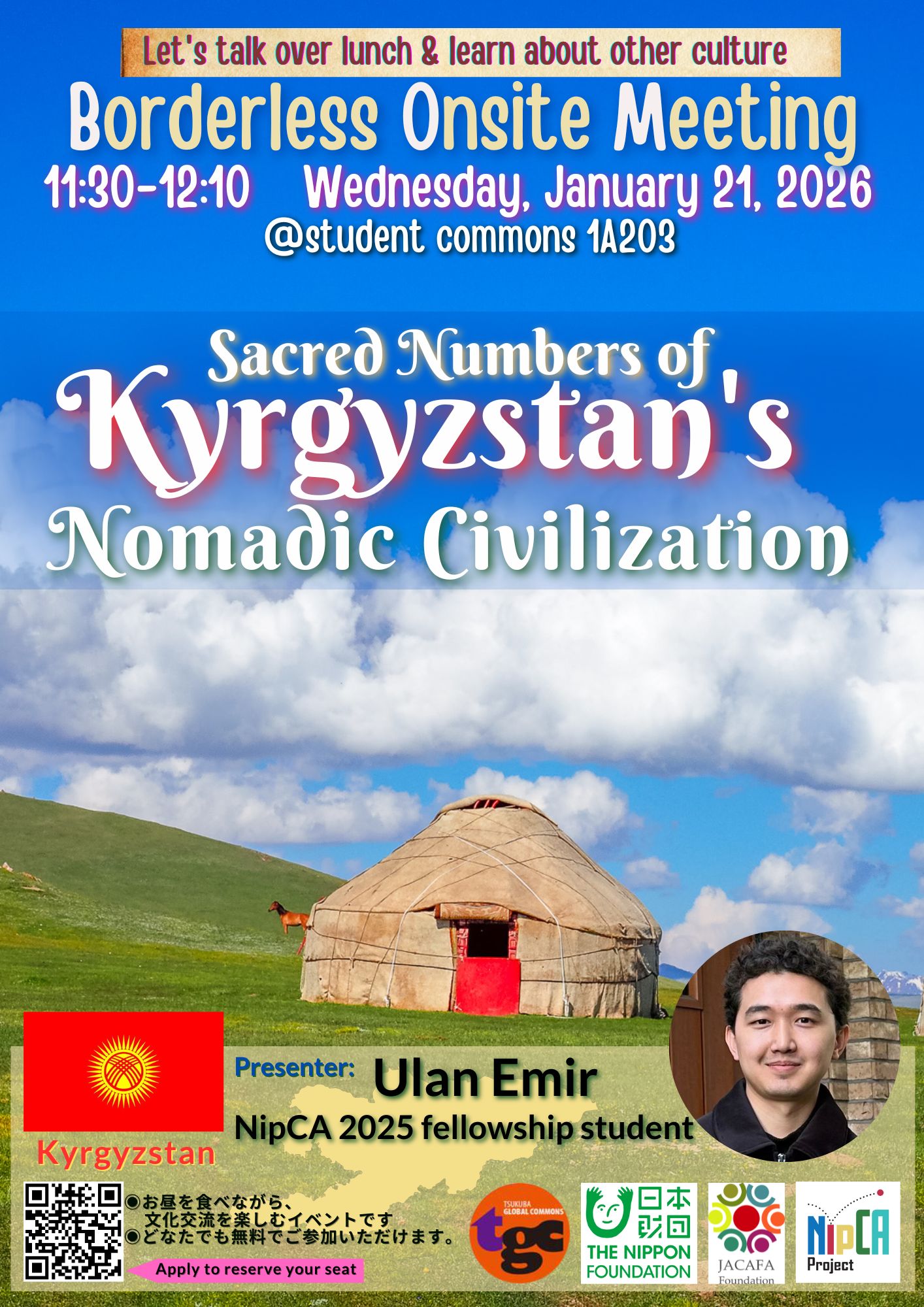
 On Wednesday, January 21, 2026, the 17th meeting of the Borderless Onsite Meeting series was held, during which Mr. Emir Ulan – one of the 2025 fellows of the Nippon Foundation Central Asia-Japan Human Resource Development Project – delivered a presentation titled “Sacred Numbers of Kyrgyzstan’s Nomadic Culture.”
According to Mr. Emir Ulan, the Kyrgyz Republic is a country in Central Asia often referred to as the “Central Asian Switzerland” due to its magnificent mountain landscapes. Kyrgyzstan is the homeland of a rich nomadic heritage in which numbers carry deep symbolic and spiritual significance. Although the modern Kyrgyz Republic was established in 1991 following the collapse of the Soviet Union, early references to the Kyrgyz people can be found in ancient Chinese historical records dating back more than two thousand years, to 201 BCE. Central to this heritage is the belief that certain numbers structure human life, social relationships, and natural order.
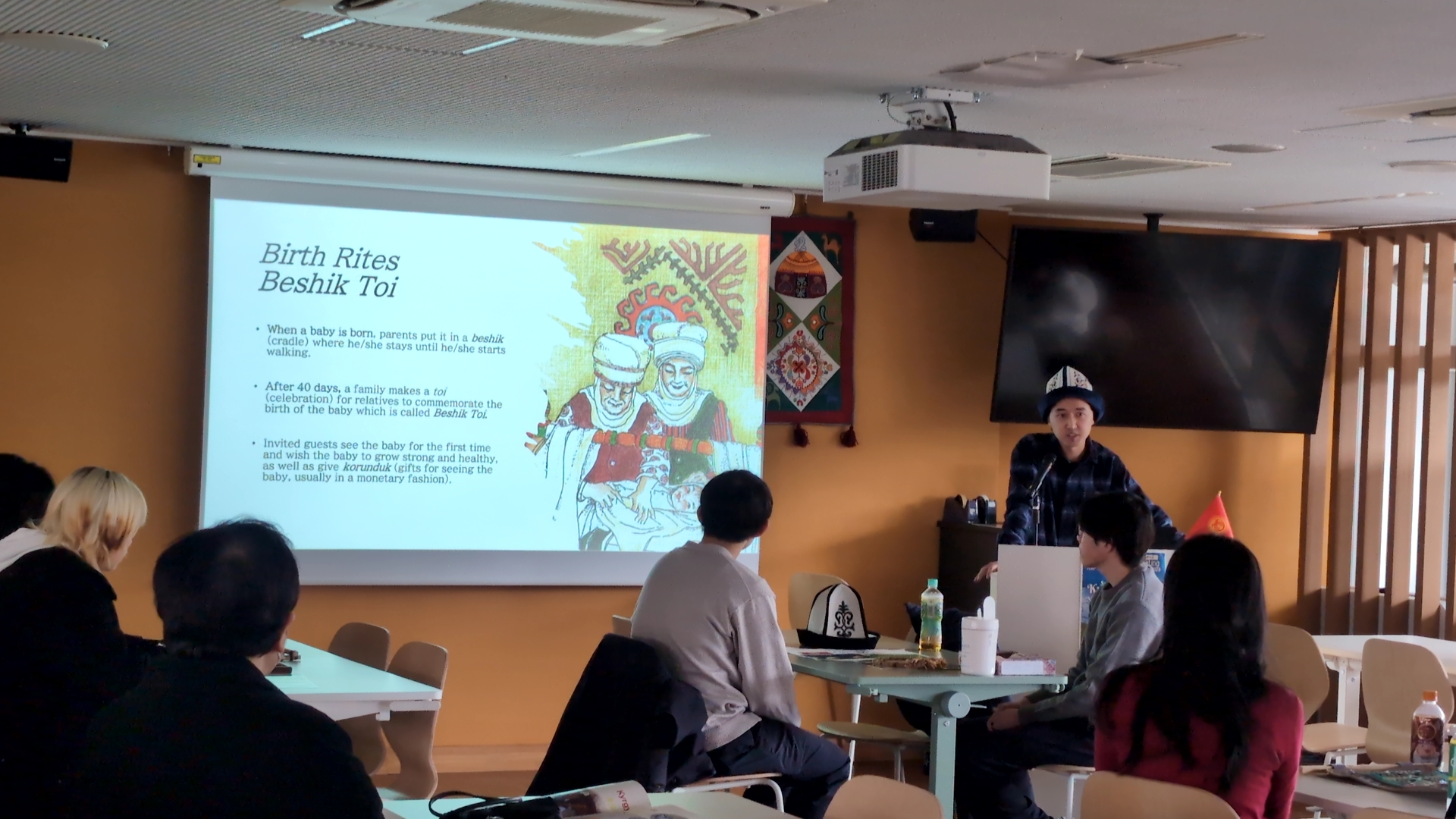
As presented, numbers play a defining role in key life rituals from the moment of birth. One of the earliest ceremonies is Beshik Toi, which is held forty days after a child is born. During this celebration, the baby is placed in a traditional cradle (beshik), relatives gather for the first official introduction, and guests present korunduk – symbolic gifts expressing wishes for health and strength. Childhood is also marked by Tushoo Toi, celebrated when a child takes their first steps. A rope made of sheep’s wool is tied around the child’s legs and ceremonially cut, symbolizing freedom, confident movement, and success as the child enters a new stage of life. For boys, another important milestone is Sunnot Toi, the circumcision ceremony typically performed at the ages of three, five, or seven. As most of the Kyrgyzstan’s population is Muslim, circumcision is regarded as a sacred duty for every boy.
Among all sacred numbers, seven holds special significance. It is closely connected to sanjyra, the oral genealogical tradition, and jeti ata, the requirement that every Kyrgyz person know the names of their seven paternal ancestors. This practice not only helps prevent marriages between close relatives but also serves as a reminder of Kyrgyz identity. The symbolic power of the number seven is also reflected geographically, as Kyrgyzstan itself is divided into seven regions.
Another key number is twelve, associated with muchol jyl, the twelve-year life cycle. Every twelve-year period in a person’s life is considered a difficult and transitional phase. During these years, people often wear red clothing or carry red items to protect themselves from misfortune and hardship.
Mr. Ulan emphasized that the most sacred number in Kyrgyz culture is forty. It appears prominently in the national epic Manas, which tells the story of the hero Manas, who united forty tribes with the help of his forty warriors known as the Kyrk Choro. The number forty is also present in death rituals: after a person passes away, relatives gather on the fortieth day (kyrky) to pray and allow the soul to finally find peace.
Through these sacred numbers, Kyrgyz nomadic culture connects individual life stages with collective memory, history, and spiritual continuity, preserving cultural identity across generations.