 Thanks to the generous support of the Nippon-Foundation Central Asia Japan Human Resource Development Project (NipCA), Professor Tkach-Kawasaki Leslie (member of the NipCA Project Tsukuba academic supervision team) was able to attend and make a presentation at the International Association for Media and Communications Research (IAMCR) Annual Conference, held Sunday, June 30 to Thursday, July 4, 2024 in Christchurch, New Zealand.
IAMCR is a key international academic organization devoted to research in media and communications. Their conferences have a long history of success, starting with the first IAMCR conference in Paris, France in 1957. IAMCR’s annual conferences are held at different venues throughout the world, which allows great diversity in attendance and presentations. According to the organization’s website, there are over 17 thematic sections and 20 working groups, and members can join up to three throughout the organization (IAMCR website, 2025). IAMCR’s annual conference is a key event for the organization, with a high standard of presentation representation and quality.
The conference theme was “weaving people together” through “communicative projects of decolonizing, engaging, and listening,” and the conference started on June 30 with welcome speeches by local authorities, the IAMCR executive, representatives from the University of Canterbury (local host), and other sponsors. The welcome ceremonies were chaired by Matheson Donald of the University of Canterbury, Chair of the Local Organising Committee. Professor Smith Linda Tuhiwai of Te Whare Wananga o Awanuiarangi, New Zealand, gave the opening keynote address.
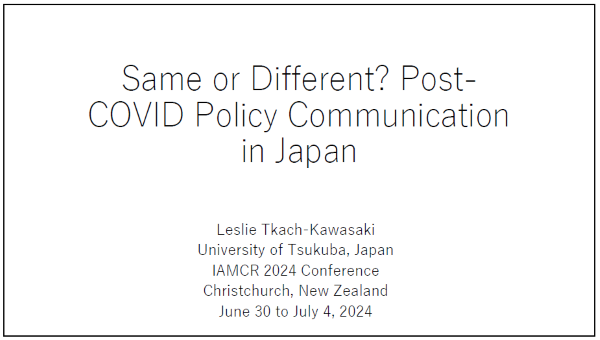
On July 1, Professor Tkach-Kawasaki presented her paper entitled “Same or Different? Post-COVID Policy Communication in Japan.” This paper looked at the “digital transformation” of election campaigns in Japan in the post-COVID era. The COVID era in Japan (roughly 2020 to 2023) witnessed a surge in online activity in many public-sector areas, and online campaigning, which started in Japan in earnest after 2013, was a particularly important resource for politicians and public sector officials, who were heretofore reliant on more traditional and offline campaign techniques. Against the backdrop of the digitalization of public services, online campaign is exhibiting both strengths and weaknesses in Japan’s electoral landscape.
The conference dinner reception was held on July 3 at the Te Pae Rivers Room in the conference venue, and the conference finished on July 4 with its annual general assembly.
I am thankful that the NipCA Project supports and encourages my research, allowing me to attend this event, discuss my research, and have insightful academic discussions with other researchers throughout the world.